
**
An A for representation to the Tate Modern on its exhibition Nigerian Modernism. With this exhibition Tate continues its bid to show representations of twenty-first century self-consciousness beyond Europe and the geopolitical North. Hence, the exhibition continues an annual focus on modernism and 20th/21st century civic consciousness in Africa. In 2024 it was a focus on South Africa through the art of the activist photographer Zanele Muholi, and in 2023 the pan-African photography exhibition “A World in Common: Contemporary African Photography”.
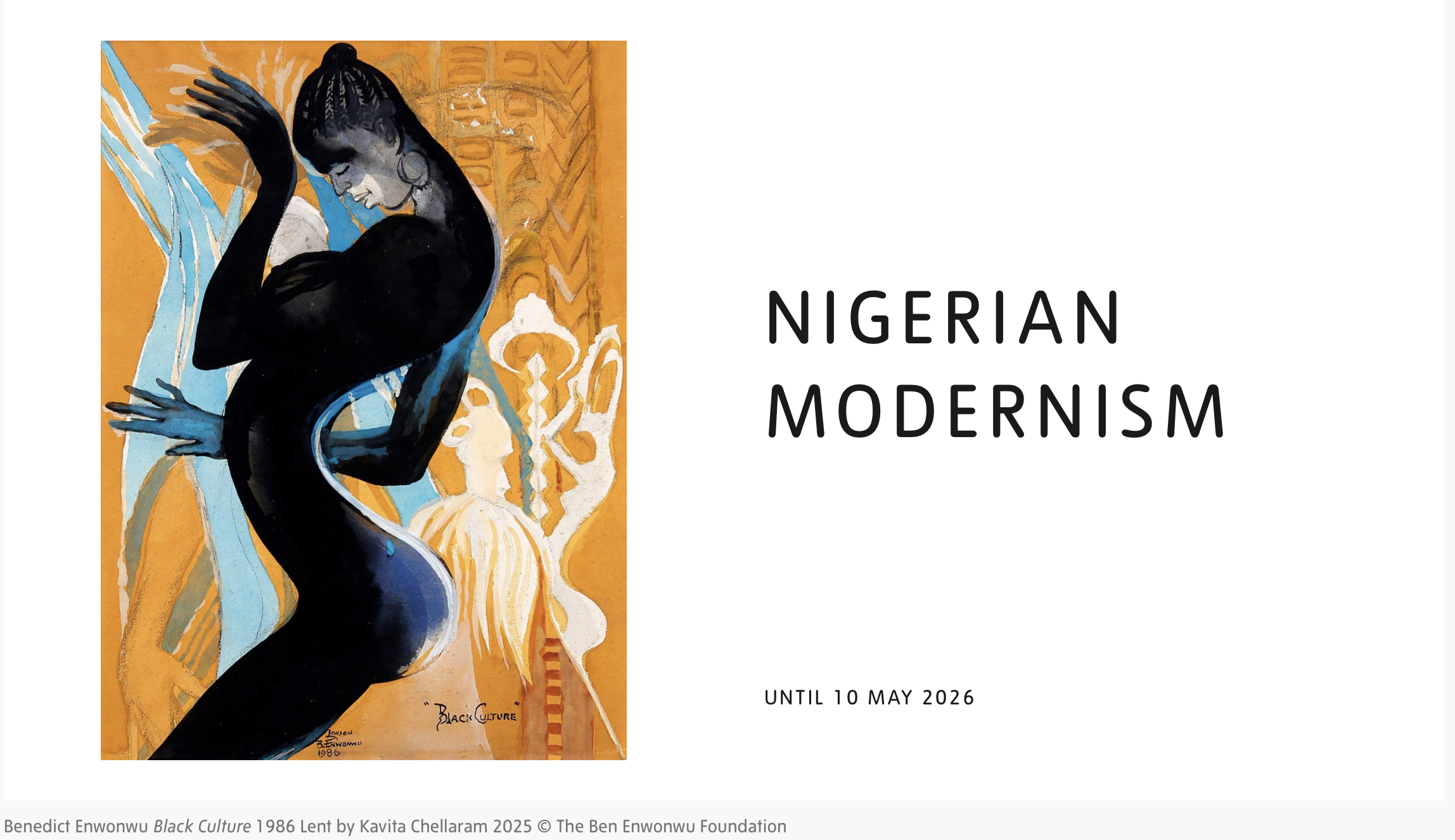
While Nigerian Modernism as suggested by Tate Modern puts art from non-Western cultures on a par with the geopolitical North, the exhibition is shallow and full of gaps. The separate rooms representing the Nsukka, Osogbo and the Zaria schools is a valid reflection, through art, of the three key tribes and geographical regions that formed a federal Nigeria, pre- and at its independence. The exhibition also had running through it, references to the Nigerian Civil War (1967–70) showing the reality of inter-tribal dynamics. However regional schools or the episode of secession are not the revelatory or challenging stories that the exhibition could tell. The deep and spectrum of stories available to the show, required the exhibition to step out of the traditional model of curating and a shift from the autobiographical/attribution obsession practiced in Western art history.
For Tate’s Nigerian Modernism the
archive at hand was not enough.
Of course curators are essentially art historians, hence their default fodder are archives. An exhibition focused on the archives is a collection, merely of low-hanging fruit, easily accessible to the curator, whether they tell a coherent story or not. For Tate’s Nigerian Modernism the archive at hand was not enough. Hence the exhibition was an anticlimax and an injustice to a living, breathing, global Nigerian community. The Tate Modern, might be located in London, Britain, Europe, but a significant part of the London audience is the Nigerian and West African diaspora which is global and in effect desire a robust representation, warts and all.
While deep; the colour palette is rich, varied and vibrant, presenting visually arresting works.
Seeing these works in succession as one installation, it becomes obvious how deep the Nigerian colour palette is, and might historically have been. This deepness is as opposed to the light, sometimes citric, colours that might be assumed about tropical cultures. While deep; the colour palette is rich, varied and vibrant, presenting visually arresting works. The richly deep palette spread through the rooms themed after the regional schools is valid, as mentioned above, especially when looking through the Western art history lens. Justice was done to the medium of painting and 2D works. Nigerian modernism, however transcended embracing the Western inspired and long honed tradition of painting and a twenty-first century digitally-educated audience deserved more, especially as more was possible
FESTAC 77
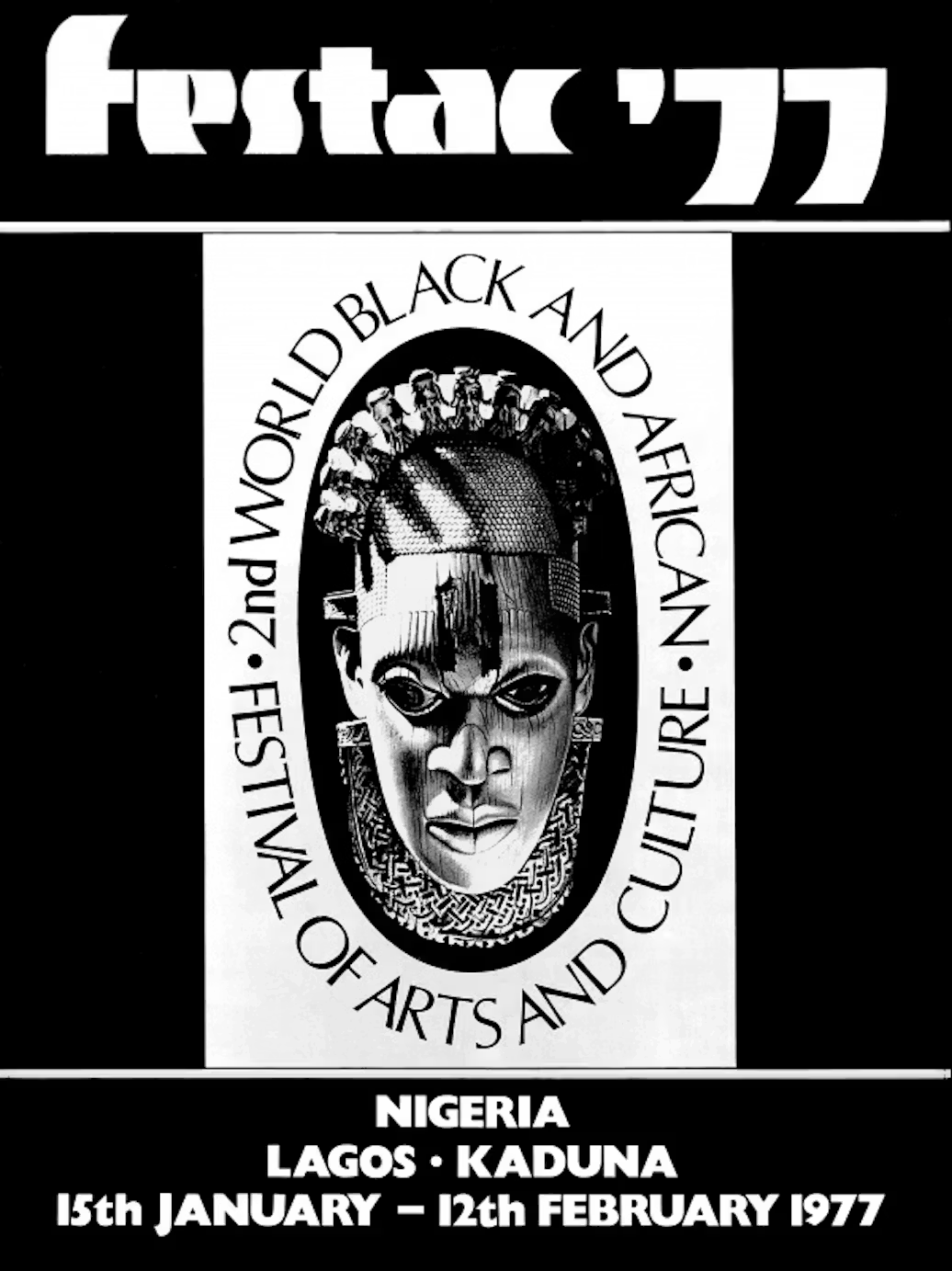
Through the medium of FESTAC 77 Nigeria used its newly acquired oil wealth to engage in the practice of soft power on the global stage.
The 2nd World Black and African Festival of Arts and Culture, popularly known as FESTAC 77, which Nigeria hosted in 1977 was handled as a footnote in this exhibition. Referred to only once and used merely as a tool to contextualise the two-day visit to Nigeria, of an artist who post his teenage years, in the 1940s, did not live or practice his art in Nigeria. There was no engagement with the significance of the 1977 Festival of Arts and Culture, not just to Nigeria, but the whole of Africa. Beyond Africa, FESTAC’s tentacles reached the African diaspora both contemporary and historical. FESTAC 77 spliced culture with history to welcome Brazilians, Afro-Cubans and others who identified as Afro-Latino or descendants of Africans globally. Through the medium of FESTAC 77 Nigeria used its newly acquired oil wealth to engage in the practice of soft power on the global stage. Especially in the context of assessing modernism in Nigeria, FESTAC is an integral part of Postcolonial Nigerian art history.
FESTAC 77 was the second of its kind in Africa. The first was the World Festival of Black Arts held in Dakar, Senegal in 1966. After FESTAC 77, there was a hiatus of 30 years. The Pan-African celebration of art and culture was kickstarted in 2010, however with irregular instalments. Nothing on the scale of FESTAC 77 has happened to date. FESTAC 77 was a tour de force of visual culture hence very much within the Tate Modern remit. The absence of the event of FESTAC 77 and its unique archive is an example of why this exhibition was a threadbare story of post-independence/Postcolonial Nigeria and a lost opportunity to showcase Nigerian modernist art practices, milestones and present a truly multimedia, immersive experience.
The absence of the event of FESTAC 77 and its unique archive is an example of why this exhibition was a threadbare story …
The digital promise made to a twenty-first century exhibition audience was broken with the absence of the FESTAC 77 footage. As an arts and culture festival in the golden age of television footage, FESTAC 77, was geared towards stage and performance which meant it generated an inordinate amount of video footage, not just by Nigerian operatives but European and American media. Furthermore, the late 1970s saw the proliferation of colour filming. An abundance of video footage colour was in sharp contrast to the lone badly lit footage of the Duro Ladipo theatre troupe in Room 8 of the exhibition.
Photography
Room 6, entitled ”Eko” focusing on Lagos, the post-independent federal seat of government, and in the 2000s the continued commercial capital of Nigeria. “Eko” was a lost opportunity to showcase the extensive Nigerian photography practice and the Modernism of its visual culture. Photography was widely embraced by Nigerians in the first half of the twentieth century, especially south of the River Niger or the Western and Eastern regions of the federation. As a Nigerian educated middle-class emerged, the use of photography as a tool of self-fashioning, was democratised. Photographic self-fashioning exploded with Nigeria’s independence in 1960. This was highlighted by, for example, Autograph’s London exhibition Abi Morocco Photos: Spirit of Lagos in 2025.
Photographic self-fashioning exploded with Nigeria’s independence in 1960.
Another example of lost opportunity in this exhibition is the example of how the Yoruba people of southwestern Nigeria used photography to reimagine practices of the cult of the Ibeji (twins). Practices of the cult of the Ibeji (twins) centred around wood carvings of statues representing twins which is given, if one of a twin set dies, to the surviving twin and their grieving mother. The transition from carved twins to symbolic photographs of twins and the creative reimagining by the Yoruba was articulated by the anthropologist Stephen Sprague in his seminal academic study of African photography practice “Yoruba Photography: How the Yoruba See Themselves”, (1979). This reimagining by the Yoruba has to be the prime example of modernising and the ultimate within visual culture of the practice of transcending to modernism. The photography the exhibition chose to showcase was the well-worn lifts from the archives of Nigeria still in its colonised state, presenting a metaphor of a still-shackled people.
Fela Kuti
Nothing could have added edginess, animation and the vibrancy of music, which the Nigerian culture has become synonymous with, like the inclusion of Fela Ransome-Kuti. Fela Kuti’s scope was beyond the music he was famous for, encompassing recorded live performances, art, fashion and international artistic collaborations. Kuti even stretched into Postmodernism, staging debate-triggering live performances. Fela Kuti’s oeuvre, would have told a robust national story and given a vivid socioeconomic context to the richly deep canvases in the exhibition. The iconoclastic Kuti was the soundtrack to an emerging modern Nigeria in the cultural, social and sociopolitical spheres.
This exhibition is more of a Western entity’s coincidental acquisitions and purview, than it is a Postcolonial assessment of … a post-independent Nigeria.
Alongside the rich palettes of paintings in the show, the exhibition hinted at other media. However the attempts at these other media were feeble and an anticlimax to a London audience that includes a noteworthy Nigerian diaspora. While the paintings served an art history narrative, within the missing media was the Nigerian story and the connection to a live and kicking global community. This exhibition is more of a Western entity’s coincidental acquisitions and purview, than it is a Postcolonial assessment of or insight into a post-independent Nigeria.
Nigerian Modernism: Art & Independence is on at Tate Modern until 10 May 2026.

 GK Art Notes