
*
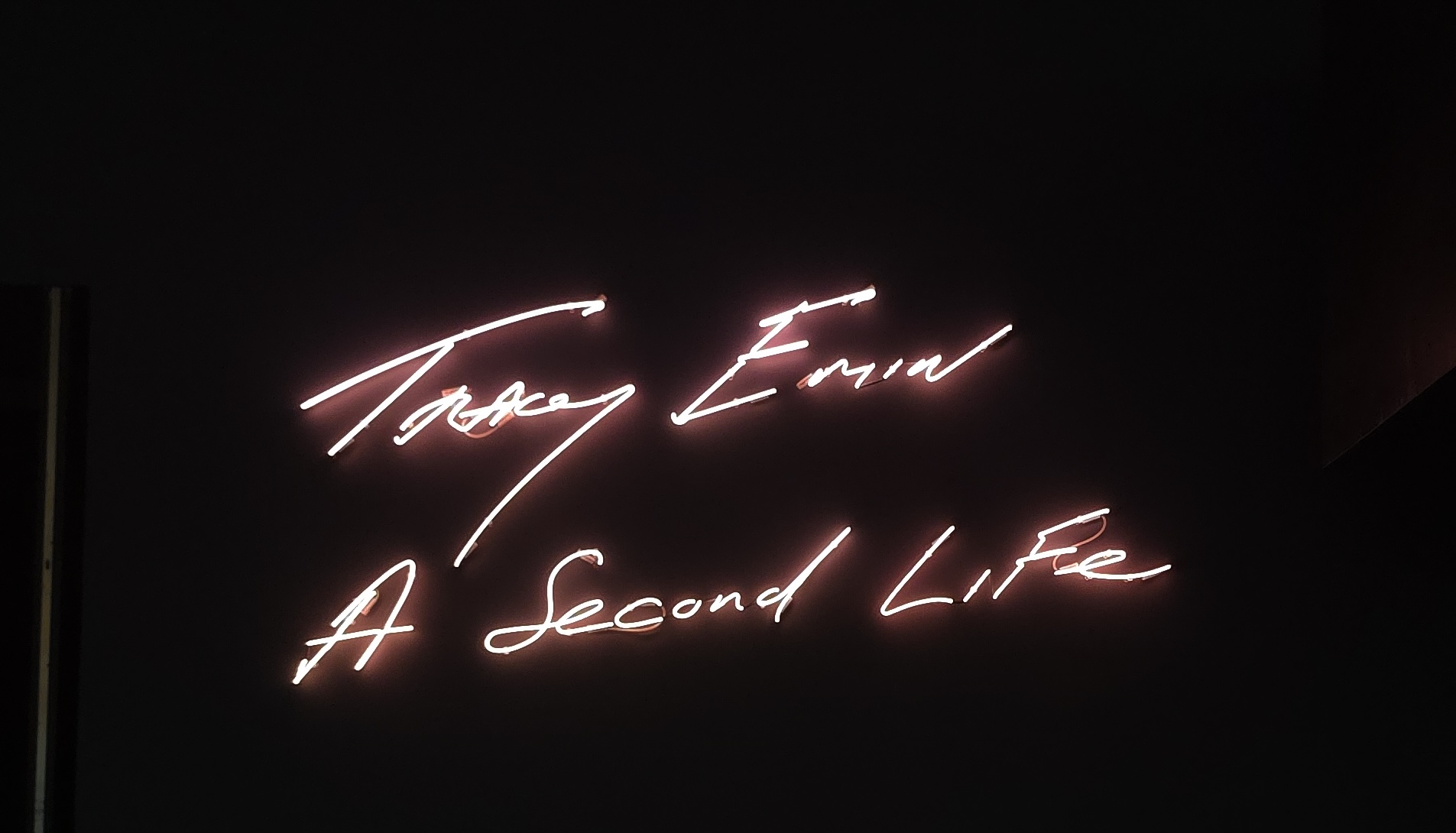
And so, what? This is the basic retort to the statement “I am here” being made by Tracey Emin: A Second Life at the Tate Modern. Failing on so many fronts, the exhibition is ultimately unable to answer the “So what?” question. Emin’s output is art, but barely so, and it is art only because the Tate says it is. And thanks to its complicity, the Tate is a partner in Emin’s failures. The Tate, however, goes further, and compounds the failure of the art by serving the public a shabby exhibition. Hence, Tracey Emin: A Second Life at the Tate Modern is a catalogue of failures: of art, as a curatorial strategy and a hanging exercise. Furthermore, on failures, is the aesthetics and anyone remotely familiar with the yBA gang of Emin, Damien Hirst, Sarah Lucas, Marc Quinn and their extended company will know aesthetic failure is not only contrived, but also their forte.
Inaccessible Exhibits
It was part of the gallery experience, both amusing and painful, watching others slowly lose the will to live as they struggled to read bad handwriting, in unconventional coloured pens, on acid-coloured papers.
Emin’s art is not opaque and demanding of deep reflection. To reflect on the art, you must be able to engage with it first. In this exhibition, many of the exhibits were visually illegible and physically unapproachable and this is surprising given the contrived and sterile space of a gallery. Right from the beginning the audience encounter barriers to engaging with the exhibition. In room 1, the barrier alarm kept going off as punters leaned closer to see the circa 6cm x 6cm elements of a 180-piece installation, entitled My Retrospective II 1982-1992. Throughout the exhibition were Emin’s personal letters, hung in groups, for us to read and get a sense of the artist. It was part of the gallery experience, both amusing and painful, watching others slowly lose the will to live as they struggled to read bad handwriting, in unconventional coloured pens, on acid-coloured papers. Ultimately, I decided not to engage with these exhibits that did not lend themselves to engagement. Torn between the artist and taking full advantage of the uniquely visual tool of a gallery, the curators folded to the artist, delivering a frustrating experience to the audience.
… Emin alludes to educating us about cancer treatment. This sort of education is on a need-to-know basis and if you are fortunate enough not to have … cancer either personally or indirectly … then you do not need to know.
This exhibition was either frustrating its audience or nauseating them. Neither the frustration nor the nausea had any artistic merit to it. The nausea came in the form of Emin’s cancer treatment/stoma gallery. Approaching the gallery a sign warns us of exhibits of “the artist’s body post-surgery, including her stoma and images of blood.” I heeded the warning and walk briskly through the gallery setting my sights literally on the light at the end of the tunnel or “vortex” avoiding the potentially unsettling exhibits. People should seek out such visceral images of their own volition and not have such images pushed on or dangled before them. In the gallery’s accompanying audio guide Emin alludes to educating us about cancer treatment. This sort of education is on a need-to-know basis and if you are fortunate enough not to have an experience of cancer either personally or indirectly, through a loved one suffering from cancer, then you do not need to know. Outside these personal circumstances, any purported education is the height of arrogance and an unnecessary imposition. Cancer is a scourge we are all aware of and through the 360 degrees surround of broadcast media we have information of how we can empathise and help even if we do not have personal experience of it. Empathy is no more possible through graphic visceral imagery, in fact sometimes it can be a hindrance to empathy.
Vacuous Naval Gazing
All in all, Emin’s art is not inspired by her biography, her biography is the art and its banal bits, of the lurid letters, the cheap and fading family photos, the graphic polaroids, and the unpoetic quotes are meant to be pedestalled exhibits. Through Emin’s output we are supposed to accept an art genre called “autobiographical and confessional artwork.” In this genre all our misdeeds, mistakes, misadventures, mistreatments and traumas are art-worthy. All Emin’s misses are not the inspiration for her art, they are her art, and quite conveniently so. The materiality of a graphic polaroid, for example, is lazily exploited and easily hung up a gallery exhibit.
This is bad art because, visually Emin’s art is not compelling, in most cases the canvases are vacant.
So, is Emin’s output art? Yes, it is, if institutions like the Tate Modern says so. The next question is then; is this worthy or good art? This is bad art because, visually Emin’s art is not compelling, in most cases the canvases are vacant. Both the canvases and the other art media present naval gazing, and this coupled with visually inept work must be the worst kind of art. The demerit of naval gazing, vacuous art is that it relies on reams of commentary for its validity. Some of the commentary that validated this show was in the audio guide the Tate published to accompany the exhibition. We should not be afraid to say this bad art, despite the endorsement of the Tate and a damehood. Afterall, Institutions sometimes get it wrong and powers are notorious for missteps and abuses. Emin herself tells us that she is prone to delusions. This was the inadvertent message couched in the Room 2 video work, Why I Never Became a Dancer, in which Emin’s dreams of becoming a dancer were thwarted by slut shaming. What is intriguing about this exhibition is seeing how the Tate buys into Emin’s delusion and in effect exhibits institutional delusions, itself.
Propaganda audios
The audio guide that accompanies the exhibition presents the extent to which institutional delusion has buoyed Emin’s career. In the guide we hear self-contradictory statements like “Tracey’s work is not about the shock tactics that some of that work was aiming for”. How can you deny being shocking if that is what you aimed to do? Or how can you object to being called shocking if you intended to shock as opposed to aesthetically entice, or elicit a deep engagement? A shock repels and shuts down. A shock might, but rarely, leads to a return, reconnection and conversation.
There is no denying lacking in beauty or just a “mess”, as worthy adjectives for Emin’s output, however used in the quote above these descriptions are pawns in the game of the “emperor’s new clothes” that cloaks Emin’s outputs.
The audio guide is more of propaganda than an education about Emin’s outputs. To justify the inclusion of Emin’s notorious unmade My Bed 1998 in this exhibition, we are told:
“…seen in the context of today… artists, writers see auto-fiction differently, the idea of owing and telling your own story without a filter. I think in the age of social media, it’s much more legible. This idea of creating a self-portrait which isn’t about you looking perfect or beautiful. It’s about exposing the reality of your life, the mess of life, the vulnerabilities, pains and struggle.”
There is no denying lacking in beauty or juts a “mess”, as worthy descriptions for Emin’s output, however used in the quote above these descriptions are pawns in the game of the “emperor’s new clothes” that cloaks Emin’s outputs. Mess and ugly are deluded badges of honour, the idea being, we the audience, validate these adjectives. The audio guide is littered with statements like the one above which makes one wonder if these supposedly highly educated commentators understand the society and times they live in. An example of not reading the contemporary room, is the quote’s reference to social media. For a voice of authority to still hold up social media as an example of authenticity and a safe place for people to bring an “(un)filtered” “self-portrait without you looking perfect” is ironic, if it was not so perplexing. It is thanks to the social media culture that the word “filter” itself with all its negative implications has literally become part of our common lexicon. It has been understood and widely accepted that most use of social media is about filtering, feigning beauty and a false representation of perfection. Furthermore, we are now aware that on the contrary, broadcasting real vulnerability through social media can at best leave you over-exposed and at the worst get you into real trouble and sometimes physical danger. The authenticity esteemed here only serves to feed voyeurism.
Worthy blankets
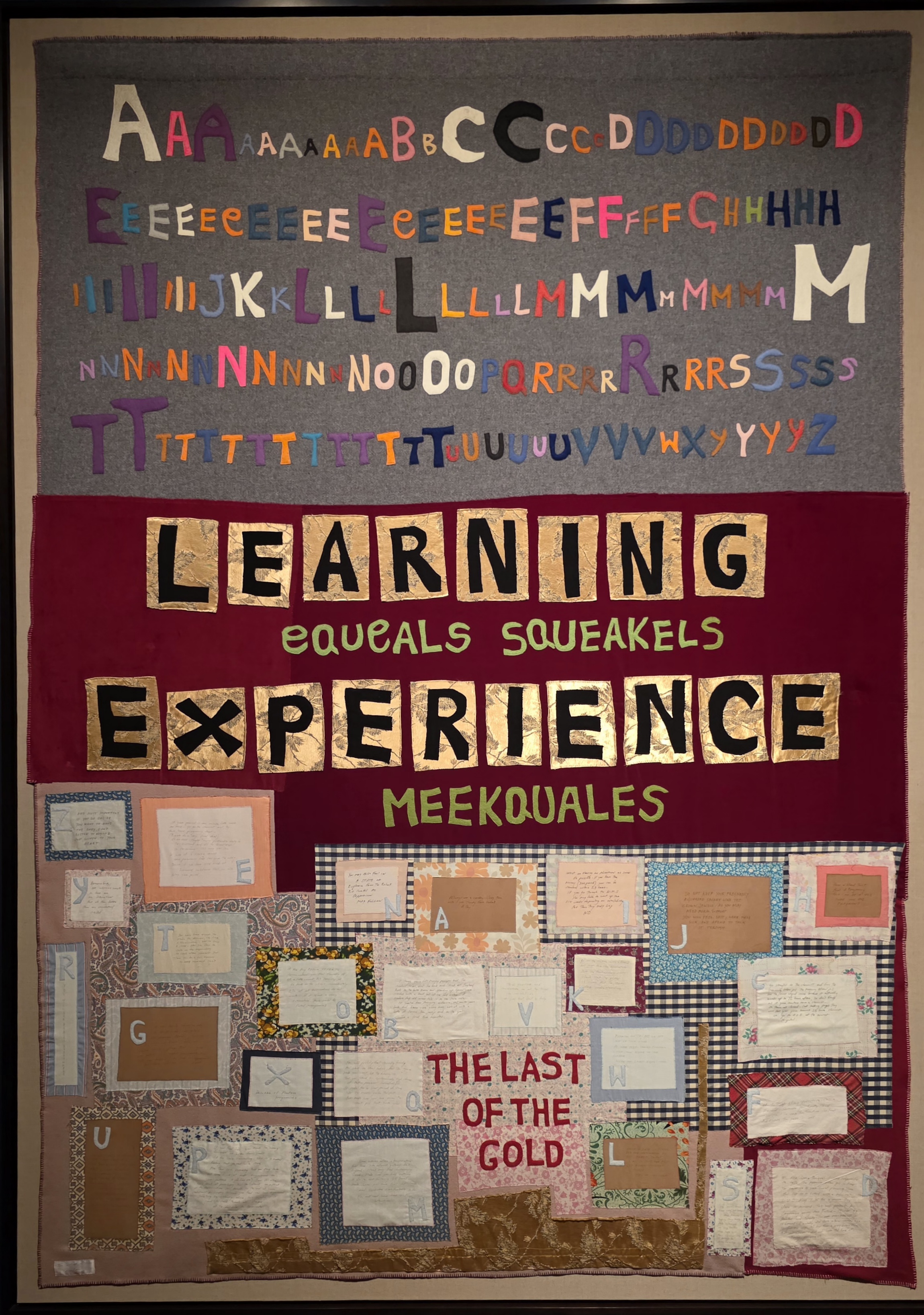
With or without bodily fluids, real or implied, Emin’s blankets work, but they are the only exhibits that do in the show.
Noteworthy, amid tired shock tactics, inaccessible exhibits and banal videos, are Emin’s texted-based applique/patchwork blankets. The text of the visually engaging blankets invites deserved curiosity. The text presents funny messages, and the spelling-mistakes and grammatical errors are amusing, although you suspect they are contrived. Even funnier are Emin’s visual device of spermatozoa in motion, appliqued in strategic locations of her blankets. Again, are we meant to be shocked? If shock is intended, again Emin is behind the curve. Well ahead of her are conceptual artists like Marcel Duchamp and Latin American artist Mario Castillo, who used their own semen as a medium in their art, creating the “body art”, and the more curiously titillating niche “semen art” genres. With or without bodily fluids, real or implied, Emin’s blankets work, but they are the only exhibits that do in the show.
While being aware of Emin for decades, this was a first experience of an exhibition of her work. Alongside the long years of awareness is knowledge of the caustic takes on Emin by critics like Brian Sewell. After seeing this exhibition the jury is in, the venom of Sewell and other critics was well aimed.
Tracey Emin: A Second Life is at the Tate Modern until 31 August 2026


