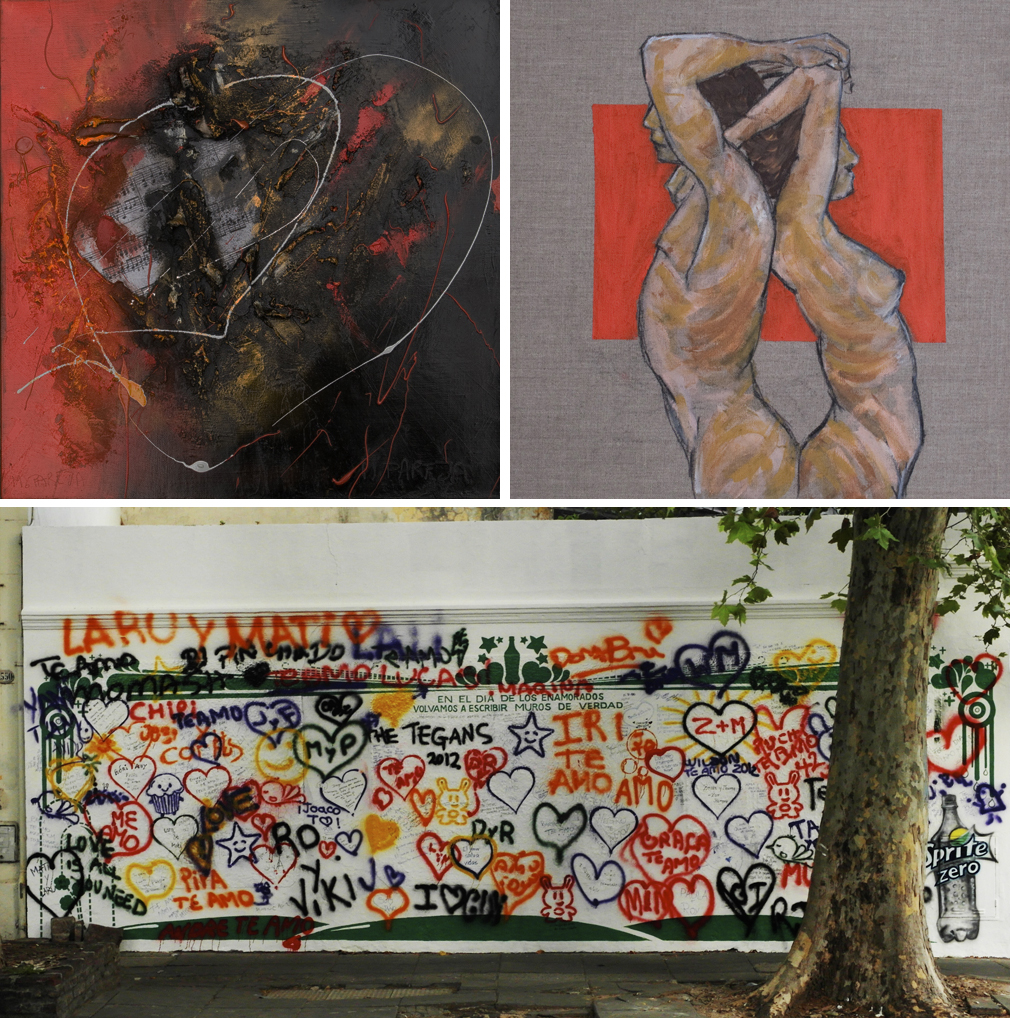
Check out these and other affordable art, GalleriaClic has, on offer for the season of love and romance!
Sign up to the GalleriaClic’s mailing list and get regular updates on the growing choice of affordable art available to you.
Check out these and other affordable art, GalleriaClic has, on offer for the season of love and romance!
Sign up to the GalleriaClic’s mailing list and get regular updates on the growing choice of affordable art available to you.
To date Enrique Gavilanes has produced landscape paintings that explore the subject of spirituality. Gavilanes’ new work focuses specifically on the sense of spirituality we gain from the knowledge of our heritage. Irrespective of the culture we each come from, we all need a sense, which has been fashioned by our ancestry, of who we are. Hence ancestry and heritage are universal themes. With the Ancestors series of artworks Gavilanes echoes that universal theme of heritage, which we all hold dear as individuals.

Using teabags, a contemporary but globally recognised item, Gavilanes alludes to the universality of the subject of heritage and ancestry. It takes a mass of individual tealeaves blended in one teabag to give a cup of tea its richness and flavour. Likewise it takes people from a spectrum of cultures and heritages to give our communities its richness and diversity. Gavilanes’ Ancestors series is even more intriguing with the knowledge that no fresh teabags were harmed in the making this art.
Gavilanes’ Ancestors series in the group exhibition Wide Open Spaces. Wide Open Spaces is on at the Espacio Gallery from Thursday 17 January 2013. The Espacio Gallery is smack bang in between Bethnal Green station on the Central line and Shoreditch High Street on the Overground line, at 159 Bethnal Green Road, London, E2 7DG.
By Depo Olukotun
Sign up to GalleriaClic’s mailing list to get notifications and updates on future art events.
Dorothy Bohm has worked as a photographer for longer than the Rolling Stones have been on the road and just like them she is still at it. The exhibition Women In Focus at the Museum of London presents the output from Bohm training her lens on women around London. This is London in its guise as the avant-garde spots of the 1990s and noughties. Documentary style, Women In Focus takes you through more of a spectrum, and less of a metamorphosis, of womanhood in the cosmopolis. There are strong themes in Bohm’s images. She reveals the feminine obsession with preening, showing it cuts across cultures. Bohm’s photographs do a lot of sniffing at. One set of images viewed, side-by-side, take a light feather duster approach to the subject of the changing role of women in the capital. Another set, dab daintily at the theme of ‘women operating in a man’s world’.
Bohm’s images do a lot of hinting at. There is no slam-dunk on the social issues we have been lulled in, by the title, to come and engage with. There are a lot of moments but no Cartier Bressonesque ‘decisive moments’. She however, comes close to delivering a slam-dunk decisive moment. It is when she turns her lens on our society’s continued obsession with the sexualised female, that she achieves this. Camden High Street 1997 is the image that aims to do the trick. This image depicts the still primal exchange between men and women in our supposed civilised contemporary London. Interestingly there are two Camden High Street 1997s on display, both talking about the same thing. While one aims for the light touch approach the other aims for the knock out blow on the same subject. See the exhibition, compare the two same-titled and same subject images and you will, no doubt, see which is which.
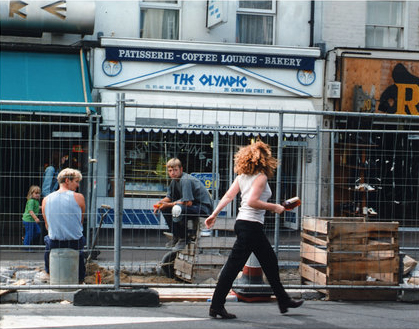
Hey caveman! What you looking at?
We live in a world where the art is defined by the story. In many cases this is not necessarily the story the art on display is telling, but the story that surrounds the art. The story might have inspired the art but not necessarily so. The story itself is defined by or has to be seen to contain specific key references; usually a recognisable social issue or the focus on a specific demographic. It is on this premise that the exhibition Women In Focus might have been given its title. With this exhibition both the story and the key reference are obviously women. As a significant demographic, women are very much in focus at the moment. Witness, the issue of ‘women in the boardroom’, which currently keeps popping up now and again in mainstream media. Add to this the education of women, which has been brought into sharp focus by the Taliban attack on Malala Yousafzai, the young Pakistani blogger on the issue of education of girls. These and other current affair topics mean in essence Women In Focus is quite rightly a timely and relevant exhibition. The exhibition however raises questions, not about society but about itself like: what is it trying to say and could it be said more forcefully?
Women in Focus: Photography by Dorothy Bohm is at the Museum of London until 17 February 2013.
By Depo Olukotun
Sign up to GalleriaClic’s mailing list to get notifications and updates on future art events.
Light from the Middle East at London’s V&A “offers insights from within cultures that are more often photographed and reported from the outside” says Jonathan Jones of the Guardian, it is not that simple and there is much more to the exhibition than the luxuries of an insight. Apart from the images from Abbas, a veteran photojournalist, most of the works in the exhibition were making myriad commentaries. Even though cameras do lie, we all know that now, Abbas tries his best to present an unloaded reportage. However all the other artists in the exhibition, most of whom seem to come from the generation after his (Abbas), embark on a deliberate dialogue some more vehemently than others, using the medium of photography.

Detail from Most Wanted by Taraneh Hemami,
It would be challenging to accept the commentary of John Jurayj for example, as an insight on the Middle East. Jurayj, though of Lebanese decent, was born and raised in the USA. At the event, Light from the Middle East: Artists in Conversation, a gig to launch the exhibition, Jurayj presented the case for his output on display. It was interesting listening to Jurayj tease about his inspiration, motif and hence his audience. While his motif might have hinted at the Middle East, may be specifically Lebanon, his artistic intention and notion of an audience was less about a window on the East and more a reflection on the West. He was not talking about any good old passive West, but the very West, which had coined the phrase ‘Axis of Evil’.
In terms of taking a swipe at the West, while Jurayj hinted, Taraneh Hemami was more blatant. Hemami’s commentary was more about being a member of what might be seen as a contemporarily and globally reviled people. Light from the Middle East reveals a people dispersed across the globe, who seem beset on all sides. At home you are faced with physical and primal danger if you were a woman, an artist, were not straight, were on the wrong side of the ruling political elite or worst still all of the above. Abroad the danger continued unless as Jurayj put it, at the launch event, you were able “to pass (as non-Middle Eastern)”.
The issues raised in the exhibition are multi-layered and complex. It reveals as much about the West as it does the Middle East. The questions raised are fundamental but not basic . What does the Middle East aspire to? How are those aspirations defined at home and abroad? What challenges are posed to the aspirations at home and, especially, abroad? The exhibition is not merely an “insight”; it is a commentary on the Middle East, by a not-so-conveniently defined Middle East, aimed not just at the West but also at itself (the Middle East). It simultaneously digs at a West and challenges a not-necessarily-passive non-Middle Eastern audience. ‘Simples’ it is not!
Light from the Middle East: New Photography is on at the V&A, until 7 April 2013.
By Depo Olukotun
Sign up to GalleriaClic’s mailing list to get notifications and updates on future art events.
Enrique Gavilanes will be showing pieces from his long running series Samil Revisited at the Espacio Gallery from Thursday 4 October. Visit www.GalleriaClic.co.uk for more details.

I am a voyager from another planet. I have just landed on your planet earth. I have, randomly, found myself in a place called Germany, the information I have picked up from the language spoken processed with my ultra-developed senses tells me this. My auto-permutation abilities, which allows me to sort information into hierarchies tells me I am at documentA (13) in Kassel. This sample of a micro-gathering of earthlings is my first experience of the planet earth.
Forgive me for asking, but are you earthlings in danger? Everywhere I go I receive messages of fear and see beautiful images of destruction. We once had a disaster in my little corner of the planet I come from. I was a child when it happened but I remember everybody radiating warnings and running, trying to get to a place safety. But here in Kassel I am confused. Your information is aesthetically pleasing and well ordered, you earthlings are not running or look scared, in fact you seem transfixed, but the message of all your well ordered information is one of destruction.
Enough about my fictional random visitor from another planet, but do you get my point. Successive documentA (13) venues I managed to visit had a fair few installations cluster around the theme of destruction. In the Fridericianum there were various pieces highlighting the almost clichéd issue of the environment. The Fridericianum set the tone for the documentA (13) installations spread throughout Kassel, as it should, it has been the centre piece of the five-yearly celebration of art since documentA’s inception. There was Amy Balkin’s Public Smog (2004 – ongoing) a particularly ambitious undertaking that included lobbying UNESCO to add the earth’s atmosphere to its World Heritage List and there was The Lost Frontier (1997-2005) by Llyn Foulkes (Image 1), to mention but a few. There was also reference made to the destruction brought on by war and international conflict, which was brought home to us in the tapestries by Hannah Ryggen.
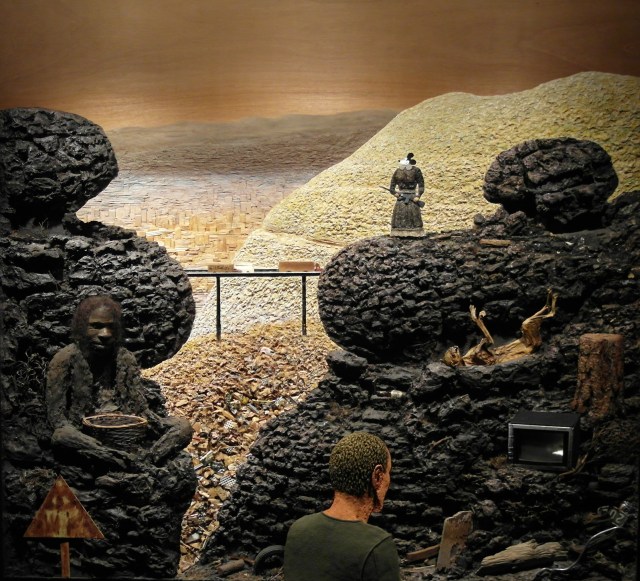
Image 1: The Lost Frontier (1997-2005) by Llyn Foulkes
The Ottoneum, is home to the Natural History Museum in Kassel and naturally the documentA (13) contributions here clusters around the subject of the earth and the environment. Most of the installations focused on the destruction happening in places as far flung (from Kassel) as the Indian Subcontinent and South America.
Thanks to Joseph Bueys’ 7000 oak documentA might forever be synonymous with the environment. However, since documentA (12) in 2007 other issues have reared their ugly heads in time for documentA (13) to engage with them. A glaring example is the global financial crisis. To this issue there was what could be described as a nod from the artist Mark Lombardi (1951 – 2000) in the Fridericianum. As far as I could see this was the sum total of documentA (13)’s contribution to the discussion on the global financial crisis. As there was a very strict restriction on how many people had access to the room that housed Lombardi’s BCCI, ICIC & FAB 1972-91 (4th version) (1996-2000) I doubt my fictional alien would have seen it, hence leaving it ignorant of the global financial crisis that seem to be engulfing the world and pushing the issue of the environment off the agenda. However, thank God for protestors and rebels. Not to be outdone by Wall Street in New York, Square Mile in London or the Eurobank in Frankfurt, Kassel had its very own “Occupy documentA” protestors (Image 2). Like documentA (13) did beautifully, according to my fictional alien, the “Occupy documentA” protestors confronted us with warnings and messages of doom. On the whole I came away thinking I hope that the magnitude of what documentA (13) is predicting, with beauty or confrontation, in its 100 days of art does not befall the earth in reality.
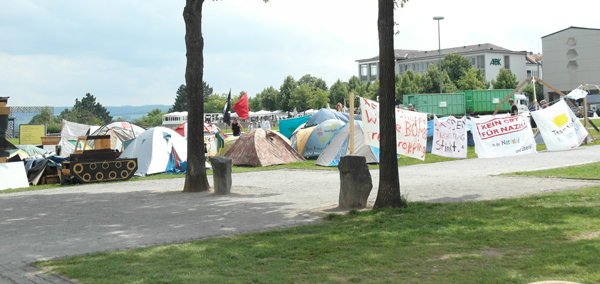
Image 2: Occupy documentA Camp
I have just come from a two-day tour of documentA (13) in Kassel, a town in the German state of Hesse. Courtesy of documentA, Kassel is the home of Joseph Beuys’ legendary 7000 oaks. Over the course of the two days at Kassel: the weather was spot on (however the heavens wept the day I left), the beer was refreshing and above all the art sucked you in! I remain convinced of the status of artists and the role of conceptual art in our contemporary existence. There was cutting edge lateral thinking to behold!
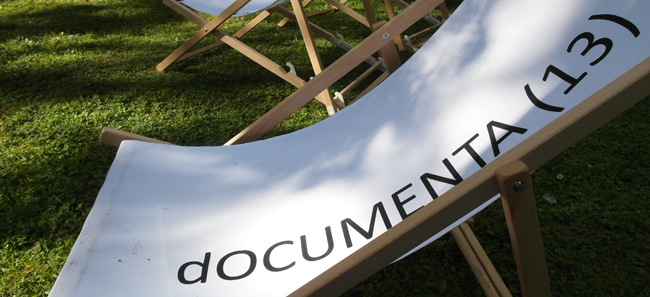
There is an art to experiencing what documentA (13) has to offer. The key is to relax and let the artists lead you by the hand. At this 100-day event there are multiple stories to be told and a multitude of ways to behold the art and hopefully have a dialogue with the individual artists. Over the coming days and weeks I aim to log successive dialogues I engaged in over the course of the two days I was in Kassel.
My aim is that each entry or log is an improvement on the last one, as I attempt to paint you an image of my take on documentA (13). There is no template of what is to come and no promises here , just hopefully a voyage of discovery. The entries are observations and hence not gospel. If this ride grabs your fancy, stay tuned to this blog and if you are digitally enabled and zealous you can engage me on Twitter or Facebook and hopefully soon on YouTube. documentA (13) ends on Sunday 16 September 2012, by which date I hope to have said all I want to say. If by 16 September I still have more to say, I shall continue, but only by popular demand, so get voting with your clicks on the GalleriaClic blog entries on documentA (13).
How many days to go at documentA (13)?
As of today there are still 68 days to go before the end of documentA (13)!
GalleriaClic’s documentA (13) recommendation of the day
Symposium: Western Sahara – a colonial conflict in our time
Read my Last entry on documentA (13).
For one scary moment I thought Beuys 7000 oaks had disappeared into Ida Applebroog’s installation on the second floor of the Fridericianum at documentA (13). All that paper (see pic)! Even if it was making use of recycled paper. Now how does this square with Amy Balkin’s UNESCO appeal?

Sign up and get art updates on GalleriaClic.
Amy Balkin is using the medium of art to lobby UNESCO on the environment.

Sign up and get art updates on GalleriaClic.
While the place to be for sports, in 2012, is London, the place to be for art as far as GalleriaClic is concerned is Germany. So far I have seen Jeff Koons in Frankfurt, next I am going up the road (well 200 miles plus of it) to Kassel for documentA 13
Sign up and get art updates on GalleriaClic.
 GK Art Notes