….something in French!

One of the diverse contributions to Matteo Merla’s I Want To Tell You crowdsourcing/art project at the Olympic Gallery, Shoreditch.
Sign up to GalleriaClic’s mailing list to get notifications and updates on future art events.
….something in French!
One of the diverse contributions to Matteo Merla’s I Want To Tell You crowdsourcing/art project at the Olympic Gallery, Shoreditch.
Sign up to GalleriaClic’s mailing list to get notifications and updates on future art events.
….something in Italian!
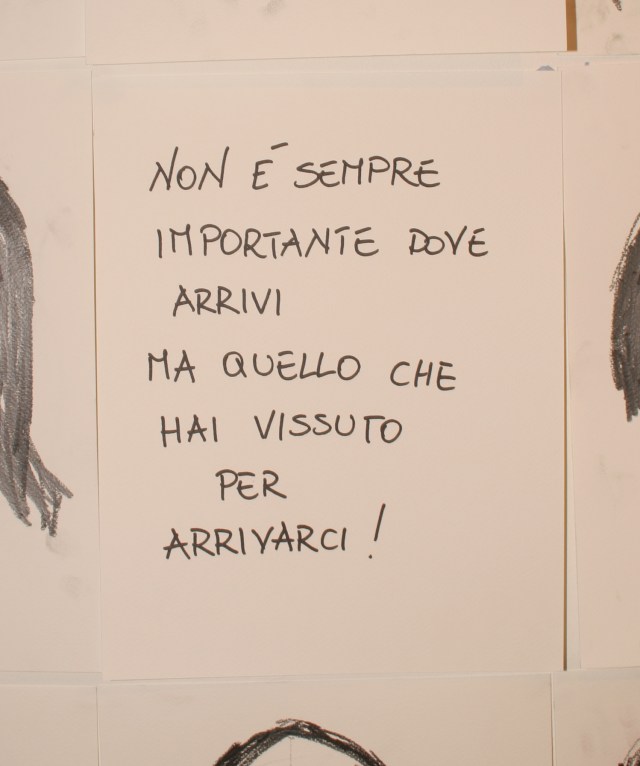
One of the diverse contributions to Matteo Merla’s I Want To Tell You crowdsourcing/art project at the Olympic Gallery, Shoreditch.
Sign up to GalleriaClic’s mailing list to get notifications and updates on future art events.
…something in Russian!

One of the diverse contributions to Matteo Merla’s I Want To Tell You crowdsourcing/art project at the Olympic Gallery, Shoreditch.
Sign up to GalleriaClic’s mailing list to get notifications and updates on future art events.
… something…

One of the diverse contributions to Matteo Merla’s I Want To Tell You crowdsourcing/art project at the Olympic Gallery, Shoreditch.
Sign up to GalleriaClic’s mailing list to get notifications and updates on future art events.
It’s our beloved monthly First Thursday again and the place to be for February 2nd’s instalment is the Olympic Art Gallery, Shoreditch.
The artist Matteo Merla is doing a mashup. Merla is attempting to prove that mashups are not the sole preserve of web development geeks. And what are the ingredients of Merla’s mashup? Essentially there is art of course; in this case randomly drawn portraits, there is crowd-sourcing; to give it a social media edge and of course there is a heavy dollop of that event of the year: the London 2012 Olympic. In fact the London 2012 Olympic have inspired the project.
Entitled I Want To Tell You, Merla’s art project is an interactive event. His crowd-sourcing attempts start by requesting his guests on the day to adopt a portrait and this is where the fun begins. More to be revealed, by the gallery, on the day. The portraits are impromptu drawings of randomly chosen faces that Merla has spotted and memorised. The exciting bit is that you get to be a part of a special installation during the London 2012 Olympic fortnight.

I Want To Tell You is at the Olympic Art Gallery. It opens on Thursday, 2 February, 6pm till 10pm. The Olympic Art Gallery is at 195 Shoreditch High Street, London E1 6LG. The nearest tube stations are Liverpool Street (Central/Circle/Hammersmith & City/Metropolitan lines) and Shoreditch High Street (Overground line). The exhibition/events goes on till Sunday 12 February 2012.
First Thursday is a monthly event. On the first Thursday of every month the galleries and museums of east London open their doors late for a chance to see amazing art, culture and events after hours.
Sign up to GalleriaClic’s mailing list to get notifications and updates on future art events.
Espacio Gallery is a collective of contemporary artists representing the gamut of visual art practise in its various guises. The original art on offer includes: abstract art, art photography, conceptual installation and video, contemporary paintings, contemporary sculpture, contemporary wall art, figurative sculpture, modern art and the list goes on. It does not matter how you choose to label what you collect or what excites you as artistic “eye-candy” there is an Espacio Gallery artist catering for you.
Geographically, Espacio Gallery is part of the London contemporary art gallery scene, however with the aid of the Espacio Gallery website it is firmly part of the global village that is the worldwide web. On the website, at collectors disposal are the list of the collectives artists, examples of their work and their contact details.
Espacio Nomadic is a series of exhibitions by the Espacio Gallery collective at different contemporary art galleries around London. The series kicked off last year, 2011, with Espacio Nomadic at the Menier Gallery. The next in the series Espacio Nomadic: Not in Transit aims to share the art limelight with the London Art Fair and why not.

The Espacio Nomadic: Not in Transit exhibition will include 17 artists from the collective and one specially invited artist. The practises, styles and artistic intentions might be legion but the aim for originality and quality are shared. So who are these artists and what has their art got to say about their practises?
Laura Bello’s soft pastel colours give a sunny-side-up feeling invoking the nostalgia for exotic trips. Judith Bieletto by contrast paints haunting scenes inspired not by morbidity but the excitement and intrigue of the darkness and the night. In Michael Blow’s carvings and sculptures the natural sciences make an intriguing alliance with art and just like the sciences they invite you to investigate. Continuing on the path of the inner depths of the soul, there is an involuntary draw to Stephanie Brunton’s ghoulish portraits; however what you will get in this exhibition is her nature inspired abstracted patterns.
Things brighten up again with Carlos de Lins’ abstracted geometry, which echoes Wassily Kandinsky’s pallete and abstraction while drawing you into a perspective the way a High Renaissance painting would, his perspective however is slightly twisted. In Julie Eccles’ photography you see the fascination and intent on capturing the purity of nature. Enrique Gavilanes unveils a curious wall hanging that has, to be seen, to be believed, he plugs into the current trend of artists accessing materials from their immediate everyday environment, popularly known as using found objects, and he does it with a twist.
Nick Hazzard uses terms like chaos, chance and accidents to describe his work, what actually registers with you visually are the rhythm of his organic shapes, the emotion of his colour and hints of geometry all working together in harmony. Stephanie Herbert shares her fascination with motion with Gerhard Richter, whose exhibition, Panorama has just finished at the Tate Modern, while Richter uses motion for stylistic effect; Herbert uses motion as a statement to illustrate a world in motion. Juli Jana’s “abstracted aerial scapes” are an optical illusion, which work on various levels depending on your proximity to them. Martin Masterson’s landscape quite simply have a forlorn beauty.
Valerie G. Montgomery’s art is unashamedly feminine, referencing the tradition of fairy tales to create drama. Chandra Morar is a social commentator in the mould of Banksy, his visually engaging images belie strong socio-political messages. Laura Reiter’s paintings tell stories of offshore folklore designed to prick your curiosity, you find yourself visually lifting her layers of motif. Renee Rilexie’s abstraction is about what is possible with colour, her idea is to set colour in motion providing a feast for the eyes and a dizziness of the senses.
Wendy Roberts uses various printing techniques to capture the visual projections trees and plants make just by being in their environment, the effects are interestingly nostalgic motifs. Alexis van El’s book sculptures are a juxtaposition of hardness with softness. The allusion to the delicacy of femininity is illustrated using sheets of metal; the overall message is feminine inner strength, which is not always apparent. Bola Adamolekun’s piece Ms Haversham’s, pays tribute to that great British institution whose centenary we celebrate in 2012, Charles Dickens. Adamolekun tells multi-dimensional stories using pottery.
Espacio Nomadic: Not in Transit (full details) previews on Friday 19 January 2012. The exhibition is at the BAR Gallery of the Willesden Green Library Centre (link to map) and is on until 10 February 2012.
Bola Adamolekun’s Gele hut is a fusion of nods to Africa, womanhood, fashion and architecture. We know what a hut is. But what is “(a) gele”?
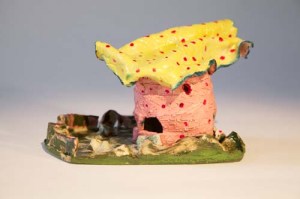
Gele Hut by Bola Adamolekun
Well it is often said that a “woman’s crowning glory is her hair” or something to that effect. However if you are a African woman you have an alternative of your “gele” (or head-tie) if you so choose to beautifully crown head. Geles are Africa’s (and if you like fashion’s) answer to origami and show extreme creative prowess. It also draws parallels with the Indian sari.
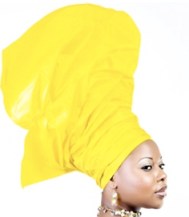


Your gele, just like your hairstyle is a form of individual expression for you as a woman. Tongues were set wagging when Princess Beatrice appeared at the royal wedding of Prince William and Kate Middleton in what is now referred to as “Princess Beatrice’s ridiculous Royal Wedding hat”. I struggle to see what the fuss was all about. It is a big shame there were no smart African women present to grace the occasion, then the poison tongues of the fashion press and blogosphere would have had something to really wag their about!

What is all the fuss about?
With her piece, the Gele Hut, Adamolekun splices fashion with architecture. Her sculpture and pottery is informed by fantasy. This is fantasy in all its forms be it western childhood fairy tales or the exuberance of the African romance with colour and expression. With the Gele Hut she echoes the pace set by that man known as “the architect of fashion”. Gianfranco Ferre famously used a training and background in architecture to inform his fashion.
How could a lone figure fill a stage and keep you entranced for nearly 90 minutes? Well Akram Khan did. And what is more he did it with poetry and contemporary grace. But then the poetry of dance and the contemporary language of choreography are Khan’s stock in trade.
DESH is an autobiographical production in which Khan collaborates with Oscar-winning art director Tim Yip (Crouching Tiger, Hidden Dragon), composer Jocelyn Pook and other notables of the international dance circuit. However DESH was not all about Khan, but the bits that were about him were quite intimate, illuminating and hilarious in varying measures. He takes us on a trip to his roots in Bangladesh and makes us witness to various guises of conversations with his father. The conversations are full of profound symbolism.
While it was busy being profound DESH does not forget to be entertaining. We are treated to hilarious interpretations of stereotypes of contemporary South Asia. Through the fusion of the media of dance and mimicry, Khan treats us to intimate conversations, profound symbolism and succeeds at entertaining us. How so? Well, Khan’s dancing is full of energetic and narrative choreography. The energetic movements and poses are surprisingly graceful, not forceful, while the narration flows in poetic precision with the movements.
There were other fusions and crossovers going on in the dance. There was the fusion of traditional South Asian dance with street dance. There is body popping fusing with contemporary dance and all other sorts of crossovers. The result was an endless, seamless and elegant flow of illustrative dance and the effect on you was transfixing.
One of the opening chapters in Desh introduces us to a riotous bustling city in Bangladesh, probably Dhaka. We are given a sense of where we are by Jocelyn Pook’s composition of lyrical and rhythmic denotations of cacophony, madness and strife. It was scary but engaging. Pook continues to help us on the journey Khan is taking us with her arrangements. Sometimes we are reassured by the sense of place she gives us, at other times we are surprised by the diversity and influences that are inevitable in a country of 142 million people with a chequered history.
Khan uses the vehicles of journeys and conversations to tell not just his story, but also that of Bangladesh and South Asia as a whole. The story of South Asia we are given here is one of strife. There are various narrations of conflict and struggles. The struggles between land and water, a profound Bangladeshi story, the misunderstanding and conflict between generations and of course the power political struggles. To hilarious effect we witness the contemporary struggles of South Asia in the setting of a call centre. The strife takes on high-octane tones when we are confronted, with the aid Khan’s illustrative choreography, by extreme torture.
However there was respite from all the strife. In one of the journeys Khan takes us, cradled in the visual animation of Yeast Culture and the story telling of Karthika Nair, we are taken on a fantasy trip through, what might be, a Bengali forest. The experience is meant to be and succeeds in being; magical. The real journey is your trip back to the fantasia of your childhood. Then Khan returned to confrontation again.
Khan is an artist and by this I mean he is much more than a dancer and choreographer. Khan is a daring artist. His prime vehicle of displaying his risk-taking, apart from this solo performance in DESH, is through his collaborations.
Khan loves to collaborate and because his choice of collaborators is so inspired and daring the result of the collaborations is always critically acclaimed.
To date he has collaborated with Oscar-winning actress Juliette Binoche (In-I, 2008 ), National Ballet of China (bahok, 2008 ), London Sinfonietta (Variations, 2006) and Sylvie Guillem (Sacred Monsters, 2006 ) to mention but a few. Khan’s triumph to date is believed to be Zero Degrees (2005), which I never saw. In Zero Degrees he partners Sidi Larbi Cherkaoui and collaborates with Antony Gormley, and Nitin Sawhney. With Desh, I believe he has raised his game.
Unfortunately DESH is on a very short run, the last show is on the 8th of October, it opened on the 4th. Now that is what I call a flash of the genius.
It’s easy to turn up your nose at community art galleries. But to do so do is to miss a trick. Community art shows are a challenge to the rose-tinted scene that straddles underground, street and high art. They are also a micro snapshot of the art world at large.
So how do we approach the visual art equivalent of the amateur dramatics society? I am tempted to say “with an open mind”, but that just sounds lame. But for the established players in the art world the challenge is getting to the community art shows in the first place. The question is how many established gallery directors, curators or artists bother with their local community art galleries or shows? Answers on a post card, please or comments below.
The higher you are in the food chain of the art world the lazier you will become. It is easier to wait for the “good art” to come to you. The artists that eventually get to ensnare your attention are the ones that have gone through the validation process and have come through on the other side or so you think. However, how often do you really get to put your discerning skills and abilities to the test?
Community art galleries are a good test for the eye. These shows are quite simply an opportunity. This is a good test of your ability to separate the wheat from the chaff. It is an opportunity to get in there early, spot and possibly snap up a rising star.
So here is the challenge and food for thought, go to your local community arts show, watch out and see if you can spot the accomplished and talented artist amongst the chaff. Believe me he or she is there amongst the watercolours of flower arrangements and the charcoals from the life drawing classes. You do not have to look to hard you just need to go and open your eyes. By the way, he or she is there, not because they are going through a fallow period. No, it’s because they are taking a break from the cutthroat world they have come to know and got tired of. Goodness me, the things I have heard!
Talk about a cutthroat world! While the artistic excellence of Rodin or Picasso are to be aspired to, do we have to emulate their record on humanity and common decency? Please note this is not a lesson in morality.
Next challenge, when you have spotted the talented interloper then try turning you attention to the watercolours of flower arrangements and the charcoals from the life drawing classes without sniggering. Why? Well if you have the staying power to return in a year or two the artist you sniggered at, a year or two ago, might just be the one you put your red dot on or better still step forward to represent.
According to Lorenzo Belenguer of the Gallery at Willesden Green, we tend to forget the benefits of these galleries and shows to the artists. This is especially for those who are new to the whole scene. These galleries and shows are a therapeutic lifeline to the artist, their family, friends and supporters. In our brave new world of X Factor and Britain’s Got Talent we forget that sometimes even great talent needs a gentle introduction to an audience.
And just by coincidence I know of one of these community art exhibitions going on at the moment. On Sunday, 18 July, I was helping with the hanging in preparation for the Brent Art Resource’s first summer show, which they have dubbed Brent Salon des Arts. It was a first for me also. The first time I was involved in any decision-making or preparation for an exhibition. Of course I have submitted works in the past, turned up on the opening evening, drank the wine and left, so this was an altogether new and exciting experience for me. The one thing I learnt was this, forget hip, forget glamour, the key to a successful hanging is a well-equipped toolbox and plenty of willing elbow grease. Brent Salon des Arts opens on Thursday 21 July 2011.
In attempt to under-promise and over-deliver the organisers of this show have described it as a show of “original artworks by up-and-coming artists…”. Please be aware this is not a deliberately attempt at playing things down its natural modesty. However the gems in this show are unmistakable.

When?
Opening show on Thursday, 21 July 2011 18.00
Where?
Willesden Green Library Centre
95 High Road
London NW10 2SF
Tube: Willesden Green on the Jubilee line
Who…?
The exhibiting artists are members of the Brent Art Resource.
And what’s more….:
The show runs until Friday 12 August 2011.

